Loading...
Loading...





Emotional intelligence in children is the ability to notice, understand and manage feelings, both their own and other people's. It shapes how a child handles frustration, makes friends, and copes with change long before they sit for their first exam. At Little Leaders, this is treated as a core part of early learning, not an optional extra bolted onto academics. Here is what parents should know about building it early, and how it fits into everyday classroom life.
Emotional intelligence for kids means naming a feeling, understanding why it showed up, and responding to it in a healthy way. A toddler who says "I am angry" instead of throwing a toy is showing early emotional intelligence. This skill grows through daily experiences, not a single lesson.
Young children are not born knowing how to handle big emotions. They learn it through repeated, guided experiences with caring adults, which is why EI in early childhood is treated as a developmental milestone, much like learning to walk or talk.
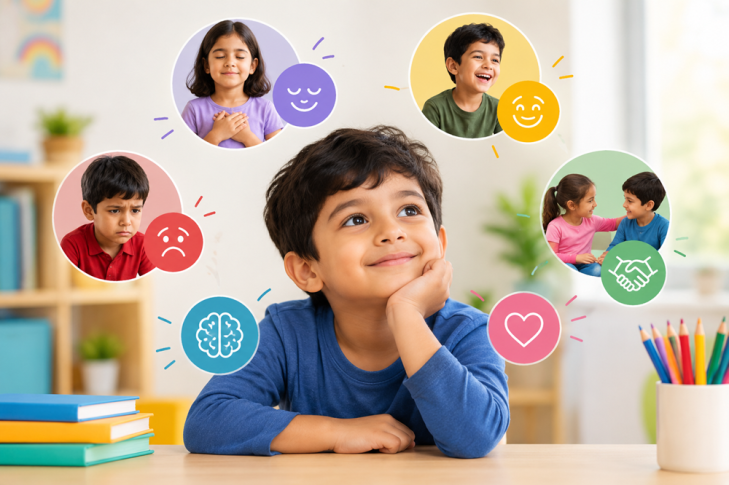
The core building blocks of EI in kids are self-awareness, self-regulation, empathy and social skills. Each one supports the next, helping a child function well in a classroom or at home. Little Leaders builds all four into everyday classroom routines.
Self-awareness is recognising what a child is feeling in the moment. Self-regulation follows next, the ability to calm down or redirect that feeling instead of being overwhelmed by it. Empathy lets a child notice how someone else feels, while social skills help them use that understanding to share, wait their turn and resolve small conflicts. These four skills grow together through play, conversation and gentle guidance from adults.
Emotional development in preschool starts early because the brain's emotional and social circuits grow fastest in the first six years of life. By the time a child enters a formal academic setting, many of their core emotional habits are already forming. Waiting until primary school to address this skips the years when the brain is most receptive to it.
A child who enters school with some ability to manage frustration or share attention with classmates settles in faster and learns better. This is why preschool years matter for lifelong emotional health, not just for early academics.
Traditional academic-focused preschool learning prioritises letters, numbers and rote memory, often measuring progress through worksheets. Emotional intelligence in children takes a different approach, focusing on how a child handles a disagreement, waits for a turn, or calms down after a setback.
Both matter, but a purely academic approach can leave gaps in a child's ability to cope with everyday social situations. Little Leaders' curriculum addresses this directly. Its 7-Dimension framework places social and emotional intelligence alongside physical wellbeing, communication and inquiry-based learning, so academic skills grow alongside emotional ones.
Everyday play builds emotional intelligence because it gives children low-pressure situations to practise sharing, waiting, losing and negotiating. A simple game of blocks or pretend play requires a child to read another child's reaction and adjust their own behaviour.
Storytelling and role play are especially useful. When a child acts out a character's feelings, they practise empathy in a safe setting. Little Leaders' reading and cultural programs use this approach, encouraging children to explore a story's characters and think about how those characters feel.
Structured group activities, music and art also give children repeated chances to manage excitement, disappointment and cooperation, without a test or grade attached.
Teachers and parents act as co-regulators before a child can self-regulate. Co-regulation means an adult stays calm and present during a child's big emotional moment, helping bring that emotion down rather than expecting the child to manage it alone. This steady support is what eventually teaches self-regulation.
A young child's brain cannot reliably calm itself without help. When a teacher kneels beside an upset child, names the feeling, and waits it out with them, the child absorbs a pattern they will later use on their own. Little Leaders' teachers are trained to respond this way rather than simply redirecting a child mid-meltdown.
At home, parents can do the same by naming emotions calmly and staying close during outbursts. Over time, children internalise this steady response and begin applying it themselves.
An EI-led environment helps children become confident learners because it gives them the emotional stability to take risks, ask questions and try again after mistakes. A child who feels safe expressing emotions is more willing to raise a hand, attempt a new activity or sit through a group task.
This shapes how Little Leaders designs its classrooms, from toddler groups through nursery. Parents can explore the curriculum on the Little Leaders website or apply for admission at a nearby Little Leaders preschool and daycare to see the approach in action.
1. How can young children learn to recognise and express their emotions?
Adults help by naming feelings out loud and using stories that show emotions in action.
2. What helps children develop self-control when they experience big emotions?
Calm routines and repeated co-regulation with a trusted adult slowly build this ability.
3. How does empathy help children build positive relationships with others?
It helps a child notice how a friend feels, making it easier to share and cooperate.
4. Why should emotional and social skills be encouraged before formal schooling begins?
The brain's emotional circuits develop fastest in the early years, giving children a stronger foundation for school.
5. How can play and everyday activities support children's social and emotional growth?
Play gives children safe, repeated chances to practise sharing, waiting and reading others' reactions.
6. What role do parents and teachers play in helping children manage difficult emotions?
They act as calm, steady guides who stay present, so children feel safe working through big feelings.
7. What is co-regulation, and why do young children need adult support to manage big feelings?
It is an adult helping calm a child's emotions before the child can do it alone, since self-regulation has not developed yet.
8. How can a supportive preschool environment help children become confident and engaged learners?
It helps children feel secure enough to try new things and make mistakes, building lasting confidence.