
Loading...
Loading...





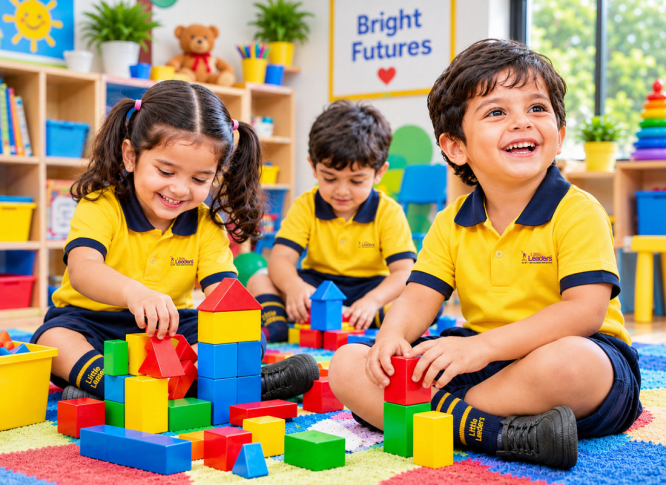
A four-year-old who can recite the alphabet is doing well. A four-year-old who raises a hand, says "I don't get it," and tries again is doing even better. Early test scores fade, but a child's self-belief stays for life. At Little Leaders Preschool in Noida, we see building confidence in children as the base for everything that follows. Here is why it matters and how a warm, caring classroom makes it happen for every child.
Confidence is quiet at this age. A confident child says hello to a new teacher, tries the puzzle again after it falls apart, and asks for help without shame. They bounce back when things go wrong.
Teachers at Little Leaders watch for these small signs every day. They show healthy preschool confidence far better than any worksheet score.
Real confidence says, "I can try, and I can learn." Overconfidence says, "I am already the best." The first accepts mistakes. The second hides them.
Praise shapes which one grows. Studies by Claudia Mueller and Carol Dweck, published in 1998, found that children praised for being smart picked easier tasks later. Children praised for effort chose harder ones. So we praise the trying, not the label.
A child who fears being wrong stays quiet. Their mind is busy guarding against embarrassment, so little room is left for learning. Harvard's Center on the Developing Child notes that stable, responsive relationships with adults are the foundation of healthy brain development.
Feeling safe to fail is where real confidence grows. When a block tower falls and the teacher says, "Let's see what happened," the child learns that a mistake is information, not shame. They try again. Each retry proves, "I can handle this."
That belief comes from the child's own effort, not from a sticker or a compliment. This is intrinsic confidence. Psychologists Edward Deci and Richard Ryan found, in their self-determination theory, that inner motivation grows when people feel capable and have some choice.
A child who is only praised for perfect results learns to chase approval. A child who is supported through mistakes learns to trust themselves. That is the heart of building confidence in children.
Curiosity needs a warm welcome. At Little Leaders, teachers answer every "why" with patience. Interactive storytelling and phonics sessions invite children to guess, wonder and speak up. A wrong answer is treated as a good try.
Parents can do the same at home. Ask, "What do you think?" before giving the answer. Share your own slip-ups, like spilling water, and show how you fix them.
Friends are a child's first mirror. Sharing toys, taking turns and solving small disagreements teach children that their voice counts. In group play at Little Leaders, children learn to listen, negotiate and cheer for each other.
Peers also show that everyone struggles sometimes. That makes mistakes feel normal. The school's focus on social-emotional skills and empathy supports this.
Children gain confidence when they can say what they need. Simple phrases like "I need help" or "I am not done yet" give them power. Independence adds to it. Zipping a jacket, packing a bag and pouring water are small jobs with big messages: "You can do this."
Teachers at Little Leaders aim to meet each child at their level. A shy child and an eager child both get space to speak and try.
Many parents ask, "Will my child fall behind if the school does not push early academics?" It is a fair worry. The answer lies in how the curriculum is built, not in how early the worksheets start.
The Little Leaders Preschool Nursery programme begins at age 3. According to the Little Leaders website, its curriculum is built on inquiry-based learning, communication skills and creative thinking. Children are encouraged to ask, explore and explain. This is exactly how confident learners are made.
Academics are still part of the day. Reading sessions use storytelling and phonics to build vocabulary and comprehension, and the site lists English, Mathematics and Science as the foundations. Sports, music, dramatics and dance sit alongside them. A child who is shy with letters may shine on stage or in a dance. That win then carries back to the classroom.
The Little Leaders website also speaks of assessment and ongoing support. In the Little Leaders Preschool Nursery classroom, this means teachers watch each child's progress and adjust, instead of comparing every child with the same bar.
An emotionally secure classroom has steady routines, kind voices and clear limits. Children know what comes next, so they feel calm enough to take risks. Teachers name feelings, comfort without rushing and celebrate effort.
At Little Leaders centres, this care supports child development in social, emotional and thinking skills together. The Nursery year is often a child's first long stretch away from home, so a secure start matters even more.
Confident children handle change better, make friends more easily and keep going when work gets hard. A 2011 review of 213 school-based social and emotional learning programs, led by Joseph Durlak and published in Child Development, found that participating students gained 11 percentile points in academic performance on average. Confidence does not compete with learning. It fuels it.
Early marks may rise and fall. A child who believes in themselves keeps growing. That is why preschool confidence deserves as much attention as letters and numbers. Parents who want to see this approach in action can visit a Little Leaders Preschool Nursery class and ask about admissions.
Q: Why is emotional development more important than academic performance in the preschool years?
A: The early years are when children learn to trust, cope and connect. Harvard's Center on the Developing Child reports that over one million new neural connections form every second in the first years of life. Emotional strength gives child development a firm base.
Q: How does a child's home environment influence their confidence and personality?
A: Home is the first classroom. Warm routines and listening adults help children feel valued. Constant criticism or pressure can make a child cautious and quiet. Encouragement, choices and patience shape a trusting personality.
Q: What happens when children grow up feeling afraid of making mistakes?
A: They avoid new tasks, stay silent and ask for constant reassurance. Some hide errors or give up quickly. Over time, this can limit curiosity and learning. Supportive adults can help reverse the pattern.
Q: How can parents recognise whether their child is emotionally secure?
A: A confident child separates from you with some ease, names feelings in words, recovers after upsets and tries new things. Steady patterns matter more than single bad days.
Q: Why do some children depend on adult approval before making decisions?
A: When children are mostly praised for results, they learn to wait for an adult's verdict. Try "You worked hard on that. How do you feel about it?" instead of "Good job." This builds their own judgment.
Q: How does giving children age-appropriate responsibilities build self-belief?
A: Small tasks, like tidying toys or watering plants, show a child they are trusted. Each success becomes proof of ability. That proof turns into self-belief over time.
Q: Can early childhood experiences shape a child's confidence later in life?
A: Yes. Early relationships and experiences set patterns for how children see themselves and face challenges. Later support can still help, but a secure start makes the path easier.
Q: How does the curriculum at Little Leaders build confidence along with academics?
A: The Little Leaders curriculum rests on inquiry-based learning, communication and creative thinking. Storytelling, phonics, music, dance and dramatics give every child a way to try, speak up and succeed.